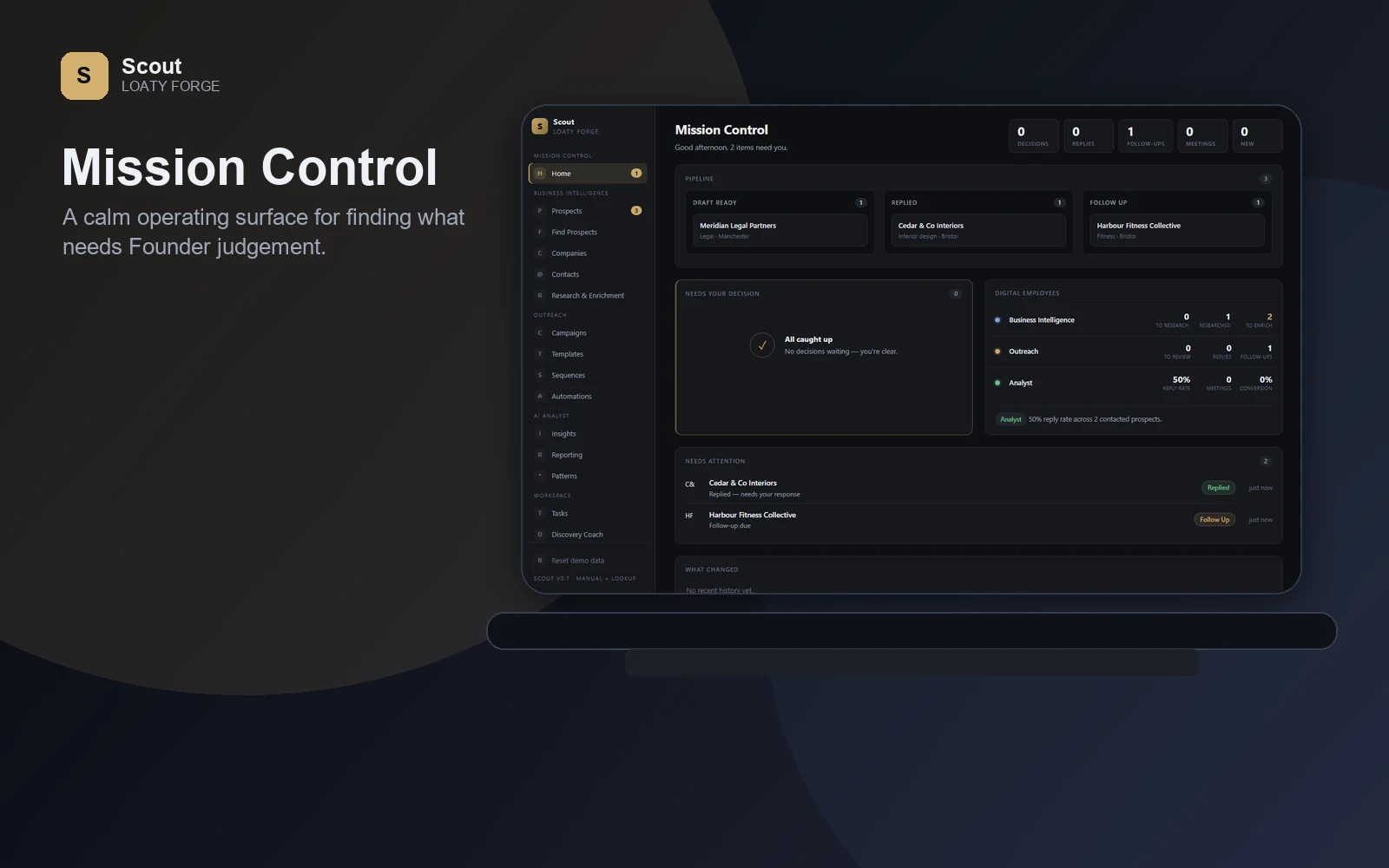
Mission Control
A calm operating surface for finding what needs Founder judgement.
Scout by LOATY Forge
Scout helps founder-led B2B service businesses find suitable prospects, understand them, prepare thoughtful outreach, follow up consistently, and learn what is working, while the founder makes every consequential decision.
Built for small B2B service firms where the founder or a small team is responsible for winning new work without a dedicated sales function.
The working problem
Finding a company is only the beginning. You still need to decide whether it fits, understand its situation, prepare a relevant approach, remember the follow-up, and learn from the response.
In a founder-led firm, that work competes with delivery, operations, and customer responsibilities. The result is often inconsistent: promising companies are not researched properly, thoughtful drafts remain unsent, follow-ups slip, and lessons stay scattered across inboxes, notes, and memory.
The Scout approach
Scout brings prospect discovery, research, preparation, follow-up, and learning into one business-development workflow. It organises the available evidence, prepares recommendations and drafts for review, and helps you see where your judgment is needed next.
Scout does not replace the relationship. It helps you enter it better prepared.
Read our practical articles on prospect research, discovery calls and outreach.
How Scout works
Identify companies that may fit the type of work your business is equipped to deliver.
Gather and organise available information so you can assess relevance before deciding to make contact.
Turn research into a reasoned recommendation, useful context, and a draft you can inspect and edit.
Review the evidence, accept or reject the recommendation, change the draft, or choose another action. The decision remains yours.
Keep appropriate next steps visible so promising relationships do not disappear into an inbox or forgotten note.
Use outcomes and responses to improve future preparation and decisions rather than simply increasing activity.
Product evidence
A calm operating surface for finding what needs Founder judgement.
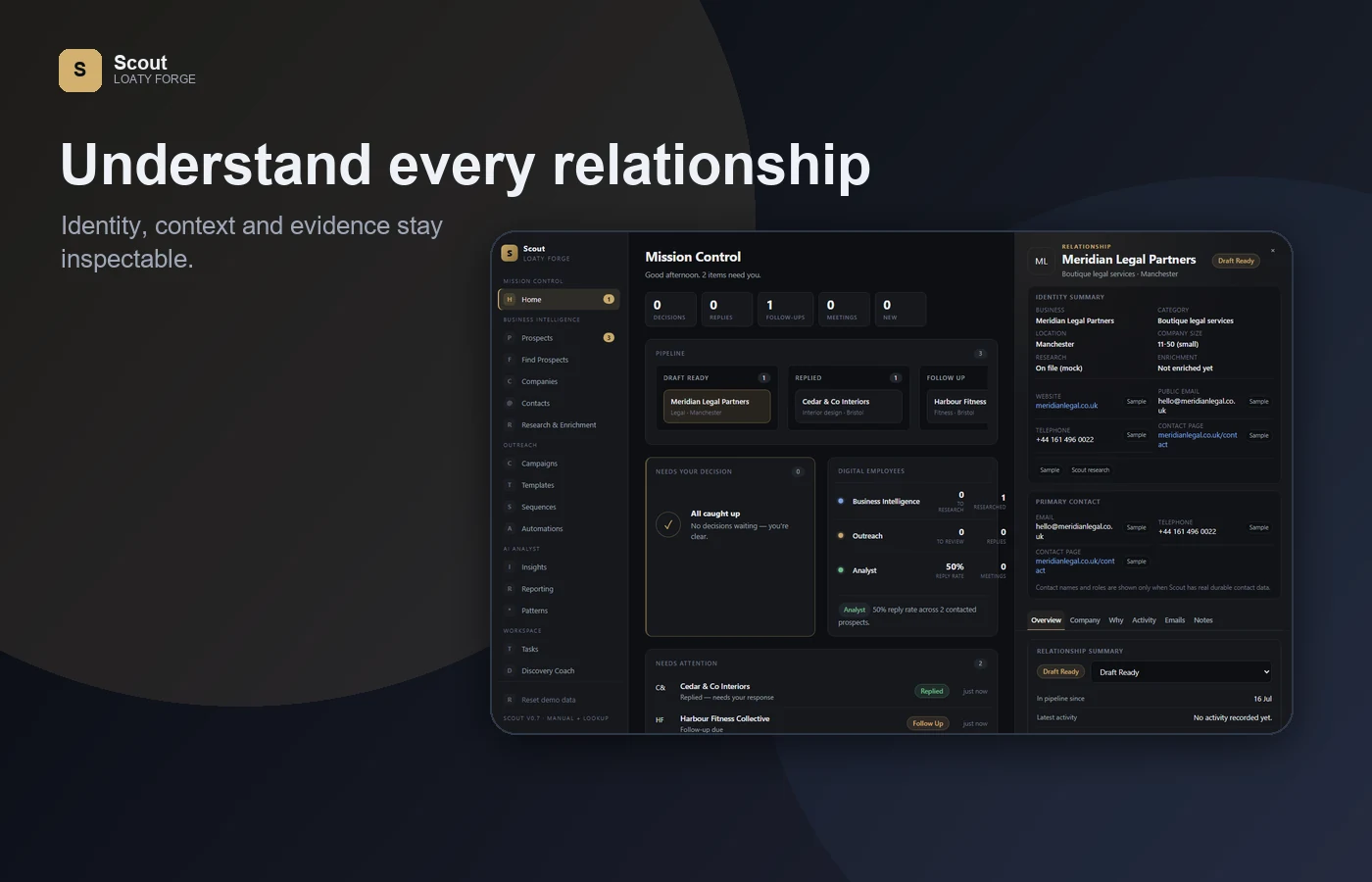
Identity, context, and evidence remain inspectable around each relationship.
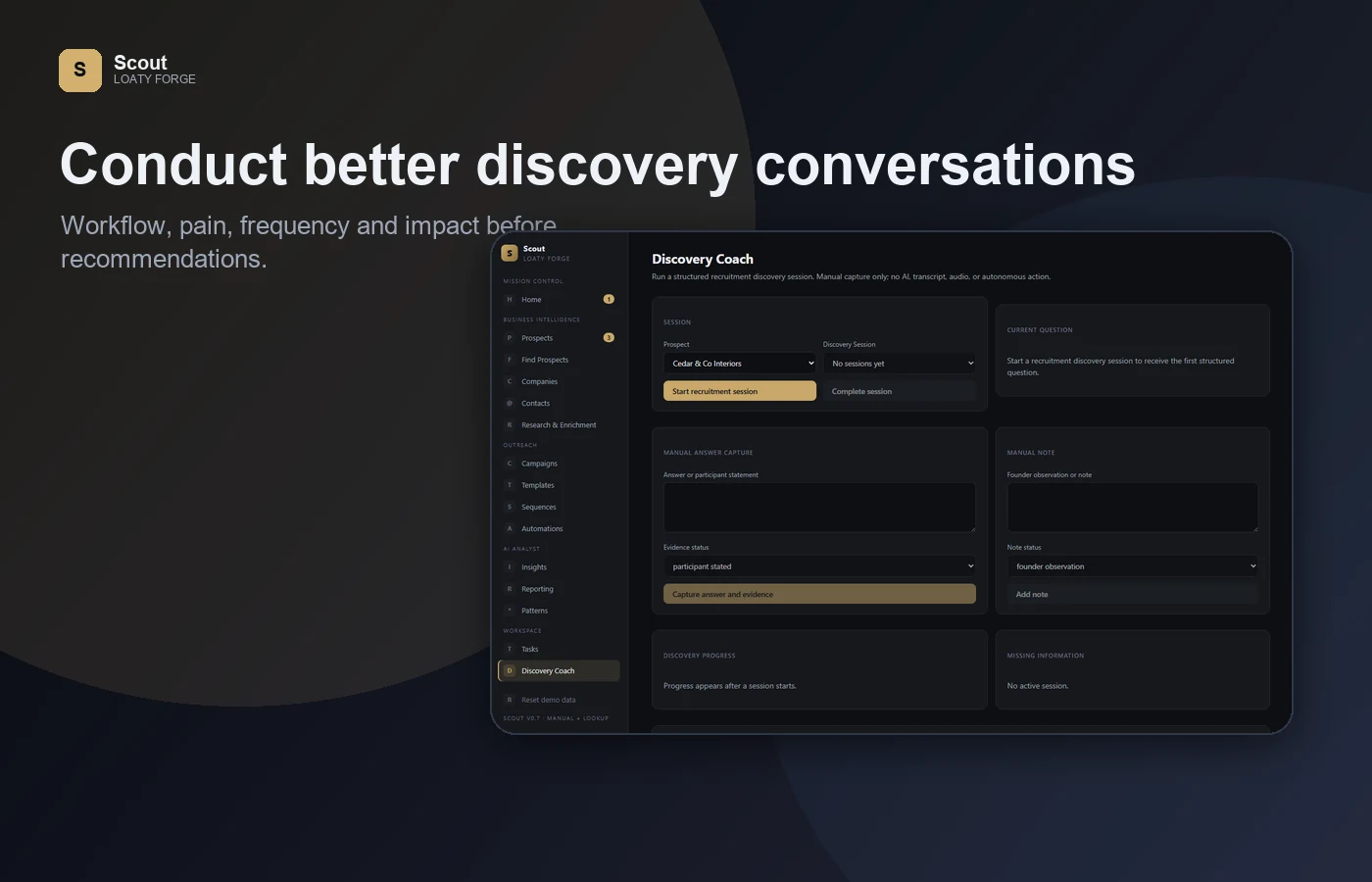
Run structured discovery conversations, capture evidence, identify knowledge gaps, and build a clear understanding of what a potential client actually needs.
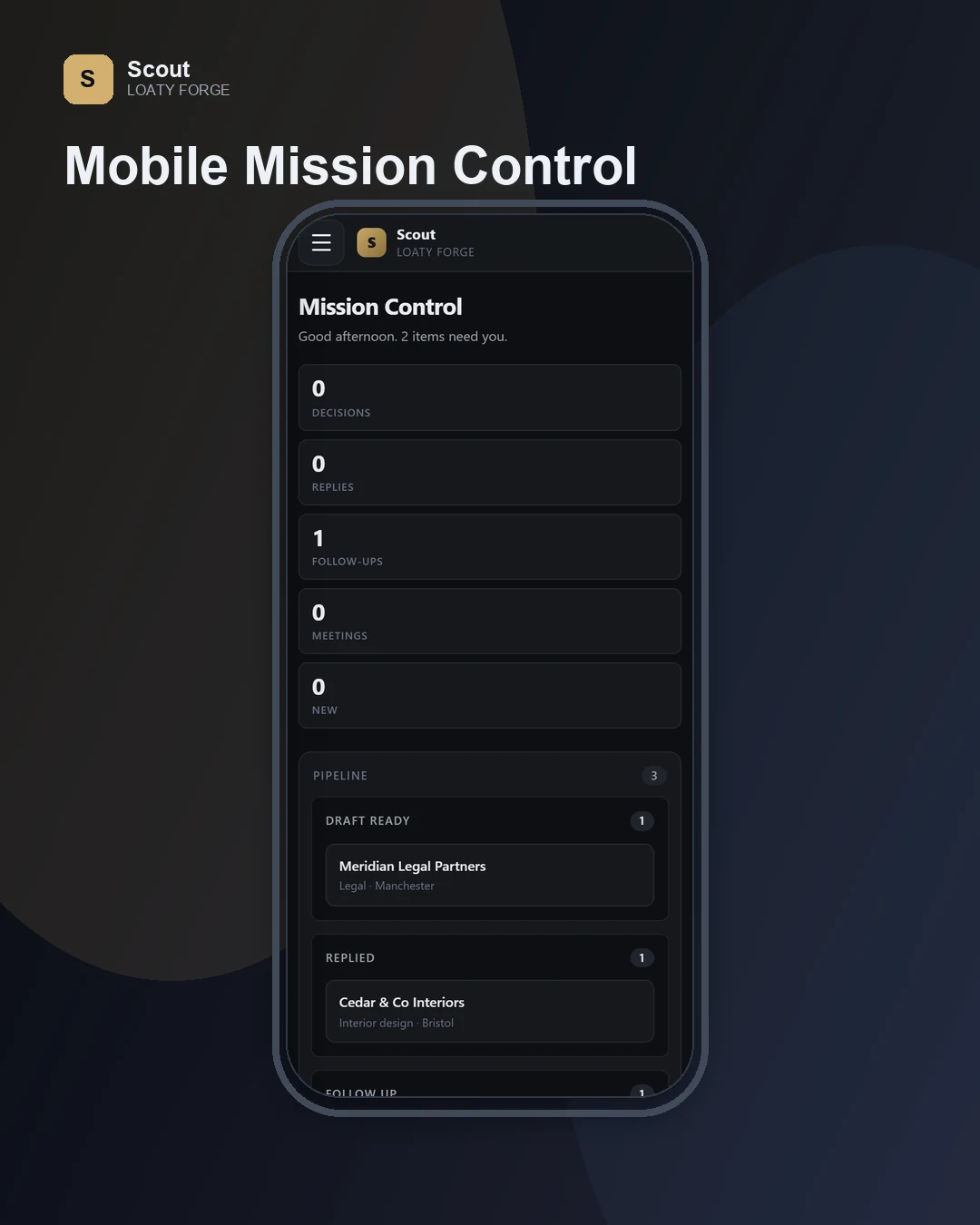
Mobile
The mobile layout adapts Mission Control into a single-column view without changing Scout's responsibility boundary.
Human approval
Scout may research, organise, draft, compare, and recommend. It does not independently send an email, place a call, issue an invitation, or make the founder’s decision.
Before consequential external action, you can inspect the basis, edit the work, approve it, reject it, or choose another path. Approval is a deliberate decision, not a setting hidden elsewhere in the product.
Benefits
Spend attention on companies that appear relevant instead of treating every name as an equal lead.
Keep the evidence needed to judge fit and prepare an approach close to the recommendation it supports.
Begin with context and a reason to make contact, not a generic message produced for volume.
Keep the next appropriate action visible while preserving your judgment about timing and tone.
Review what happened so future choices can improve instead of repeating the same process without reflection.
Category fit
A CRM records relationships. A prospecting database supplies names and details. An email platform sends messages. Scout’s job is to support the connected judgment between those categories: whom to consider, what to understand, how to prepare, what deserves follow-up, and what can be learned.
Scout may work alongside other tools. It is designed for businesses where relevance, reputation, and founder judgment matter more than sending the largest possible number of messages.
Fit
Scout is designed for:
Scout is not designed for:
Current maturity
Scout already supports real business-development work, including prospect discovery, research, outreach preparation, follow-up support, and review. It remains in controlled validation while usability, trust, customer fit, reliability, and the commercial model are tested with appropriate care.
Access is not automatic. A request helps LOATY Forge understand your business, whether Scout currently fits the work, and whether the available level of support is appropriate. Requesting access does not guarantee acceptance or imply a paid commitment.
Origin
Scout began with a practical tension familiar to small service businesses: winning new work requires consistent specialist discipline, but the founder is already responsible for delivery, operations, and relationships.
LOATY Forge built Scout to strengthen that work without replacing the founder’s judgment or turning business development into indiscriminate activity. The origin explains the product’s focus; continued validation must prove its value for other founder-led firms.
FAQ
Core maturity and human-control facts appear in the answers below and elsewhere on the page—never only in a collapsed panel.
Tell us how your firm currently finds, researches, approaches, and follows up with prospective customers. We will review whether Scout is appropriate for the work and the current validation stage.